Factory robots can repeat the same motion for hours, but repetition alone won't rebuild manufacturing. The larger change comes when robots take on tasks that are dull, unsafe, or too hard to staff, while people handle setup, checks, and unusual work.
For a plant manager, the useful question is practical: which task should move to a robot first, and what must stay under human control?
- Repetition suits robots: fixed paths and steady cycle times make automation easier to measure.
- Sensors change the job: cameras, force sensors, and safety scanners let a robot react to its surroundings.
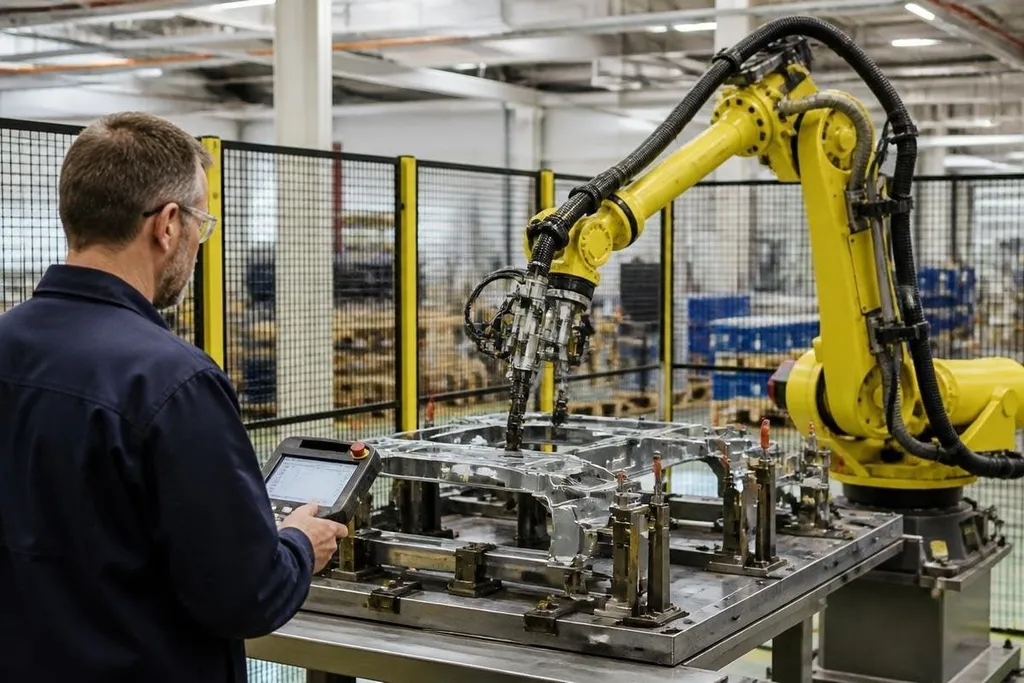
- The work cell matters: the arm, gripper, software, guards, and people must function as one system.
Start with the task, not the robot
A robot arm works well when the task has a clear start point, a clear end point, and limited variation. Loading a part into a machine, fastening the same set of screws, or moving a finished item to a conveyor can fit that pattern.
The arm's reach, payload, and cycle time set the basic limits. Payload means the weight the arm can carry, including the gripper.
Cycle time is the time needed to finish one repeated job. Those numbers let a plant compare the robot with the current manual process.
A six-axis arm can move its tool through several angles, which helps it reach around a part. It still needs the right end effector, the tool attached to its wrist. A suction tool may suit flat boxes, while a two-finger gripper may suit rigid parts.
That choice changes the whole work cell. The wrong gripper can lose time on every pick, even when the arm itself has enough speed and reach.
Sensors make fixed work more flexible
Older automation often depended on parts arriving in one exact position. Modern cells can add cameras, force sensors, and LiDAR, which measures distance with laser light, to handle small changes in part location or nearby movement.
A camera can check whether a part is present before the arm moves. A force sensor can detect contact during insertion, so the arm can stop before it bends a component. A safety scanner can pause motion when a person enters a marked area.
These tools don't remove the need for good factory design. They add more points to test, clean, and maintain. Dust on a camera lens, a changed part finish, or a new light source can affect what the system detects.
That is why the first robot task should have a narrow range of conditions. A plant can learn how the sensors behave before it gives the cell a harder job.
The work shifts around the robot
Automation changes more than the arm's motion. Someone must load material, clear faults, check output, replace tooling, and update the program when the product changes.
This creates new work for technicians and engineers. They need to understand robot positions, safety zones, machine signals, and basic fault logs. Operators also need a clear way to pause the cell and restart it after a safe check.
Before a plant changes a cell, its team needs more than a vendor’s cycle-time claim. Robot24.com can connect factory robot reports with named tasks, test dates, and measured results. That gives the team a clear starting point for the process check that follows.
The strongest factory plan also measures the process before installation. Record how long the task takes, how often errors occur, how many people support it, and what happens when a part arrives out of position. Without that starting point, a plant can't tell if the robot changed the result.
Where factory robots still struggle
Programmed arms can repeat a move with high consistency. They don't understand a new part in the same way a skilled worker does, and a small change in shape, texture, or placement can force a new setup.
Changeovers can also limit the business case. If a cell needs hours of manual adjustment for every short production run, the robot may spend too much time waiting. A slower arm with quick tooling changes can suit that plant better than a faster arm that takes longer to reset.
Safety adds another limit. A work cell needs guards, emergency stops, safe access points, and a control system that limits motion when people enter the area. The exact design depends on the robot, the tool, the material, and the task.
I'd start with one repeated task and measure it for a full production period before adding a second robot. That approach gives the team a real failure record instead of a clean demonstration.
A practical factory checklist
Use these checks before approving an automation project:
- Name the task: write down the part, motion, handoff, and expected result.
- Measure the starting process: record cycle time, error rate, staffing, and changeover time.
- Check the robot fit: compare reach, payload, speed, tool weight, and IP rating with the work area.
- Plan the faults: decide who clears jams, what stops the cell, and how the system reports errors.
- Test the changes: run different part positions, lighting conditions, surface finishes, and production batches.
- Price the whole cell: include tooling, guarding, software, training, service, and spare parts.
A factory robot earns its place when the full cell produces a clear result over normal production, not when the arm completes one clean cycle. The next decision is measurable: choose one task, record its current numbers, and see whether the cell improves them without adding a new safety problem.